

Dual environmental thresholds and indications of reversible growth-mode regulation in Adenium dhofarense under Dhofar’s hyper-seasonal climate
Author: TAKUYA KAGAWA
Affiliation: Independent Researcher, Succulent Saika, Japan
Corresponding author: Takuya Kagawa
ORCID:https://orcid.org/0009-0008-5006-3292
DOI:https://doi.org/10.51094/jxiv.2234
Abstract
Adenium dhofarense is endemic to the Dhofar region of southern Oman, where it experiences an extreme hyper-seasonal climate: a prolonged cool, clouded monsoon (khareef) followed by a brief post-monsoon interval of intense heat and high irradiance. We monitored 20 seedlings over 216 days under outdoor conditions in Japan, documenting caudex growth across varying temperature and light regimes. Under conditions adequate for congeners, A. dhofarense exhibited severe growth suppression. Rapid growth commenced only when high temperature (≥35°C) and high daily light integral (≥23 mol m⁻² day⁻¹) co-occurred, producing 3.5-fold growth acceleration. These thresholds closely match Dhofar’s post-monsoon environmental conditions (40–45°C, estimated 25–31 mol m⁻² day⁻¹). The abrupt, reversible transition between slow-growth and rapid-growth states—triggered strictly by dual-threshold attainment—suggests a potential shift between distinct metabolic modes, possibly involving facultative engagement of C₃-like photosynthesis from a CAM-like default state. This interpretation, while requiring direct physiological validation, is consistent with adaptation to Dhofar’s narrow annual growth window. The strict environmental dependency renders A. dhofarense vulnerable to climate-driven alterations in monsoon timing or intensity, with direct implications for conservation of this endemic species in one of Arabia’s most climatically unique ecosystems.
Keywords: Adenium dhofarense; photothermal threshold; Dhofar monsoon; hyper-seasonal adaptation; facultative CAM; climate vulnerability; desert plant conservation
Introduction
Adenium dhofarense (Rzepecky, 2015) is restricted to the coastal escarpment of Dhofar, southern Oman, where it inhabits one of the most climatically unusual environments occupied by any member of the genus. The Dhofar region experiences the khareef, a southwest monsoon (June–September) that produces persistent orographic cloud cover, resulting in cool temperatures (22–28°C) and severely reduced solar irradiance. Following monsoon withdrawal, conditions shift abruptly to extreme heat (40–45°C maxima) and cloudless skies during a brief post-monsoon interval (October–November), creating a narrow window of maximal temperature and light availability (Horisk et al., 2023, 2024). This sharply pulsed climatic regime contrasts fundamentally with the more predictable rainfall-driven seasonality typical of other Adenium habitats across eastern Africa and the Arabian Peninsula. The Indian Summer Monsoon plays a critical role in modulating Arabian Peninsula climate, with strong monsoon years intensifying subsidence and adiabatic warming over the region (Attada et al., 2019).
Despite horticultural interest since its description, A. dhofarense remains physiologically undocumented. Preliminary cultivation reports describe unusually slow seedling growth compared with congeners, yet no quantitative data exist regarding environmental requirements or growth thresholds. Understanding whether this species exhibits habitat-specific physiological constraints is critical for multiple reasons. First, identifying the environmental conditions necessary for growth activation allows assessment of the species’ ecological strategy in relation to Dhofar’s extreme seasonality. Second, determining whether growth responses are reversible and threshold-dependent provides insight into potential metabolic flexibility—particularly relevant given that some succulent taxa exhibit facultative shifts between photosynthetic modes in response to environmental cues. Third, quantifying the species’ environmental requirements is essential for assessing conservation vulnerability, as desert-adapted species are particularly vulnerable to climate change (Vale & Brito, 2015), and endemic plant species occupying narrow climatic niches face heightened extinction risk under shifting environmental conditions (Midgley & Thuiller, 2007).
Here we document seedling growth responses of A. dhofarense across varying temperature and irradiance regimes, quantify environmental thresholds required for growth activation, and demonstrate that these thresholds correspond closely to Dhofar’s brief post-monsoon climatic window. We further evaluate whether the observed growth patterns—characterized by an abrupt, reversible transition between slow-growth and rapid-growth states—are consistent with a shift between distinct metabolic modes. While direct physiological assays are required to confirm the mechanistic basis of this threshold-dependent growth, the phenological evidence suggests a potential adaptive strategy in which the plant maintains a low-energy metabolic state during extended unfavorable conditions and engages rapid carbon assimilation only during the brief interval when both temperature and irradiance maxima coincide. This represents the first quantitative documentation of hyper-seasonal growth requirements in Adenium, revealing an extreme adaptation with direct conservation implications.
Materials and Methods
Study system and cultivation conditions
Seeds of A. dhofarense were germinated on 16 April 2025 in 6-cm pots containing pH-adjusted peat moss under outdoor conditions in Amagasaki, Japan (34.7°N, 135.4°E). Because no physiological information was available for this newly described species, seedlings were initially maintained under partial shade (~50% natural shading) as a conservative precaution—a protocol not employed for well-characterized congeners such as A. obesum or A. somalense (treated as a synonym of A. obesum in POWO/Kew), which are routinely cultivated under full sun from germination. Seeds of A. somalense were germinated on 24 June 2025 under full sun exposure, providing a congeneric reference. By late June, A. dhofarense exhibited atypical stress responses (leaf abscission, growth arrest) despite conditions normally adequate for Adenium seedling development. All seedlings were transferred to full sun on 1 July (Day 76). On 30 July (Day 105), one representative individual (D-1) showing typical recovery trajectory was selected for detailed quantitative tracking.
Measurements
Caudex diameter was measured with digital calipers (±0.01 mm precision) at the widest stem base point. Measurements were recorded opportunistically when morphological change was detected. Air temperature and solar irradiance data were obtained from the NEDO METPV database (Kobe station, 34.70°N, 135.21°E, ~20 km distant). Daily light integral (DLI, mol m⁻² day⁻¹) was estimated from horizontal global irradiance using standard conversion factors (PPFD ≈ irradiance × 2.1) and accounting for typical daytime irradiance distribution. Although these are estimates rather than on-site measurements, the reproducible growth response pattern—minimal growth under moderate conditions, rapid growth when both temperature and irradiance thresholds are met, and dormancy reversion when conditions decline—demonstrates that conclusions regarding threshold-dependent growth are robust.
Results
Early seedling responses under partial shade and moderate temperatures
During the initial 76 days under partial shade with maximum temperatures of 30–33°C, A. dhofarense seedlings exhibited minimal caudex expansion, poor leaf retention, and frequent leaf abscission. Expansion of even a single leaf required several weeks. Despite adequate hydration and absence of pathogen damage, growth remained stagnant. Following transfer to full sun on Day 76, qualitative improvements occurred over 3–4 weeks: leaf retention increased and turgor improved. However, caudex enlargement remained limited. By Day 105, caudex diameter of focal plant D-1 was 9 mm, representing minimal growth despite continuous exposure to elevated irradiance (DLI ~17–19 mol m⁻² day⁻¹). These observations indicated that increased irradiance alone was insufficient to induce substantial growth in the absence of high temperature. In contrast, A. somalense maintained continuous growth across the same conditions.
Rapid growth occurs only when high temperature and high irradiance coincide
Marked growth acceleration was first observed between late July and mid-September, when maximum daily temperatures consistently exceeded 35°C and estimated DLI frequently surpassed 23 mol m⁻² day⁻¹. Under these combined conditions, D-1 exhibited sustained caudex diameter increases from 9 mm (Day 105) to 23.8 mm (Day 156)—a 164% increase over 51 days (mean growth rate ~0.29 mm day⁻¹). This rate was approximately 3.5-fold higher than the pre-acceleration phase (Days 76–105: ~0.08 mm day⁻¹). The growth transition was abrupt and temporally aligned with joint occurrence of elevated temperature and irradiance. Days with high irradiance but temperatures ≤33°C did not induce rapid growth; similarly, days with temperatures ≥35°C but reduced irradiance (<20 mol m⁻² day⁻¹) showed no growth acceleration. This pattern demonstrates that A. dhofarense requires concurrent attainment of both environmental thresholds to transition from slow, stress-tolerant growth to rapid biomass accumulation.
Reversibility of growth response under declining conditions
As seasonal temperatures declined below 32°C in mid-October and DLI decreased, D-1 exhibited marked growth rate reduction, transitioning toward dormancy. By 18 November (Day 216), when maximum temperatures had fallen to 21°C and DLI to ~16 mol m⁻² day⁻¹, D-1 had undergone complete leaf abscission. Growth cessation aligned precisely with loss of threshold conditions, demonstrating reversibility of the growth response.
Discussion
Dual environmental thresholds define growth activation
This study demonstrates that A. dhofarense exhibits a dual environmental threshold (≥35°C maximum temperature, ≥23 mol m⁻² day⁻¹ DLI) governing growth activation. Neither elevated temperature nor high irradiance alone was sufficient to induce rapid growth; only their concurrent occurrence triggered the transition from slow, stress-tolerant growth to rapid biomass accumulation. This strict dual-threshold requirement represents an extreme case of environmental dependency within Adenium, contrasting sharply with congeners such as A. somalense, which maintained continuous growth across a broader range of conditions.
Correspondence with Dhofar’s post-monsoon window
To assess whether the observed thresholds correspond to native habitat conditions, we estimated DLI for Dhofar’s seasonal climatic phases using available solar irradiance data for the Salalah region (17.0°N, 54.1°E). Global horizontal irradiance (GHI) in Salalah ranges from 4.7 to 7.5 kWh m⁻² day⁻¹, with seasonal means of approximately 5.9 kWh m⁻² day⁻¹ during summer (June–September) and 6.1–7.5 kWh m⁻² day⁻¹ during autumn (October–November) (Rao et al., 2024). Converting GHI to estimated DLI using the relationship DLI ≈ GHI × 4.1 (assuming 10-hour daylight and standard PAR conversion factors) yields baseline estimates of 24–31 mol m⁻² day⁻¹ for cloud-free conditions.
During the khareef monsoon (June–September), persistent orographic cloud cover (>80% cloud fraction) and high atmospheric humidity (>85%) severely attenuate direct solar radiation. Under these conditions, effective DLI is reduced to an estimated 5–8 mol m⁻² day⁻¹, accompanied by cool temperatures (22–28°C). Following monsoon withdrawal in October, cloud cover dissipates rapidly, and the post-monsoon interval experiences near-maximal solar irradiance (estimated DLI 25–31 mol m⁻² day⁻¹) coupled with extreme heat (40–45°C maxima). This brief post-monsoon window—typically lasting 6–8 weeks before onset of the prolonged dry season—represents the only period during which both high temperature and high irradiance co-occur in Dhofar.
The environmental thresholds documented in cultivation (≥35°C, ≥23 mol m⁻² day⁻¹) closely match Dhofar’s post-monsoon conditions (40–45°C, 25–31 mol m⁻² day⁻¹), demonstrating that A. dhofarense is adapted to a narrow annual growth window defined by the brief interval between monsoon withdrawal and dry season onset. Neither the prolonged khareef period (adequate moisture but insufficient temperature and irradiance) nor the extended dry season (adequate irradiance but insufficient moisture) provides conditions meeting both thresholds simultaneously. This hyper-seasonal growth strategy contrasts sharply with congeners occupying environments with more extended favorable seasons, and represents an extreme case of phenological specialization within Apocynaceae (Horisk et al., 2023, 2024).
Hypothesis: Reversible metabolic switching as an adaptive strategy
The abrupt, reversible transition between slow-growth and rapid-growth states—triggered strictly by dual-threshold attainment—suggests a potential shift between distinct metabolic modes. Under sub-threshold conditions, A. dhofarense exhibited minimal growth, frequent leaf abscission, and apparent metabolic down-regulation. When both temperature and irradiance thresholds were met, growth accelerated 3.5-fold within days. Upon declining environmental conditions, the plant reverted rapidly to dormancy with complete leaf abscission. This pattern is consistent with a metabolic strategy in which the plant defaults to a low-energy, water-conserving state and engages high-activity carbon assimilation only during brief favorable intervals.
Although we do not present direct physiological data (gas exchange measurements, diel titratable acidity, or carbon isotope discrimination) to confirm photosynthetic mode, the observed growth behavior is reminiscent of facultative shifts between CAM and C₃ photosynthesis documented in other succulent lineages. In facultative CAM systems, plants may employ nocturnal CO₂ uptake and water-conserving metabolism under stress conditions, then shift to daytime stomatal opening and higher photosynthetic rates when environmental conditions become favorable (Lüttge, 2008). The dual-threshold requirement observed in A. dhofarense—simultaneous high temperature and high irradiance—aligns with conditions known to optimize C₃ photosynthesis while providing the thermal and energetic conditions necessary to support high metabolic activity.
This interpretation remains a hypothesis requiring physiological validation. Gas-exchange measurements comparing stomatal behavior, CO₂ uptake timing, and net photosynthetic rates under contrasting environmental conditions, combined with diel acid accumulation assays and stable carbon isotope analysis, will be essential to determine whether the threshold-dependent growth transition reflects shifts in photosynthetic pathway utilization or alternative regulatory mechanisms. Nonetheless, the phenological evidence for reversible, threshold-dependent growth mode switching is robust and represents a novel pattern within Adenium. If confirmed physiologically, this species would exemplify a strategy in which low-energy metabolism serves as the default state, with facultative engagement of high-activity photosynthesis restricted to brief windows of extreme environmental favorability—an adaptive response to Dhofar’s hyper-seasonal climate where extended periods of marginal conditions are interrupted by short, intense favorable intervals (Horisk et al., 2023, 2024).
Conservation implications of strict environmental dependency
The strict dual-threshold requirement observed in A. dhofarense carries significant conservation implications. Climate models project substantial alterations in Arabian Peninsula precipitation regimes under future warming scenarios, with potential shifts in monsoon timing, intensity, and duration (Rao et al., 2024; Nelli et al., 2025). Extreme precipitation events are projected to increase in frequency and intensity across the region (Ehsan et al., 2025), potentially disrupting the predictable monsoon-to-dry season transition that defines Dhofar’s annual climate cycle.
Any climate-driven changes that reduce post-monsoon window length, decrease peak irradiance (through increased aerosol loading or altered cloud patterns), or moderate temperature extremes could push environmental conditions below the species’ growth activation thresholds. Given that A. dhofarense is endemic to a restricted elevational band on the Dhofar escarpment and exhibits no apparent ability to sustain growth under sub-threshold conditions, populations may face direct demographic consequences if the annual growth window contracts or disappears. Desert-adapted species with narrow climatic niches are particularly vulnerable to rapid environmental change (Vale & Brito, 2015; Midgley & Thuiller, 2007), as accelerating aridification challenges plants to adapt more rapidly than evolutionary timescales typically permit (Lichter-Marck & Baldwin, 2023).
Furthermore, the documented threshold dependency suggests limited physiological plasticity relative to congeners, potentially constraining the species’ capacity to respond to rapid environmental change through phenotypic adjustment. Conservation strategies for A. dhofarense must therefore consider not only habitat protection but also monitoring of climatic trends affecting the post-monsoon window, as alterations in this brief but critical period could determine long-term population viability. Understanding the adaptive limits of endemic desert flora is essential for predicting ecosystem responses to climate change and developing effective conservation priorities in climatically marginal environments.
Broader implications for understanding Adenium physiology and desert adaptation
This study reveals that A. dhofarense operates within an unusually narrow environmental envelope compared to congeners, requiring simultaneous attainment of high temperature and high irradiance thresholds to achieve rapid growth. The strict environmental dependency, combined with the reversible nature of the growth response, raises fundamental questions about metabolic diversity within Adenium and the evolutionary pathways that have shaped physiological adaptation to extreme desert environments. Whether similar threshold-dependent metabolic flexibility exists in other Adenium species, and whether it represents a shared ancestral trait or independent adaptation to hyper-seasonal climates, remains to be determined through comparative physiological studies across the genus.
Conclusions
This study demonstrates that A. dhofarense exhibits a dual environmental threshold (≥35°C, ≥23 mol m⁻² day⁻¹ DLI) governing growth activation, and that these thresholds correspond closely to Dhofar’s brief post-monsoon climatic window. The abrupt, reversible transition between slow-growth and rapid-growth states suggests a potential shift between distinct metabolic modes, possibly involving facultative engagement of C₃-like photosynthesis from a CAM-like default state, though this interpretation requires direct physiological validation. This represents the first quantitative documentation of hyper-seasonal growth requirements in Adenium, revealing an extreme adaptation to one of Arabia’s most unusual climatic regimes. The narrow environmental envelope within which this species operates renders it vulnerable to climate-driven alterations in monsoon dynamics, highlighting the importance of understanding physiological constraints when assessing conservation priorities for endemic desert flora in climatically marginal environments.
Figure Captions
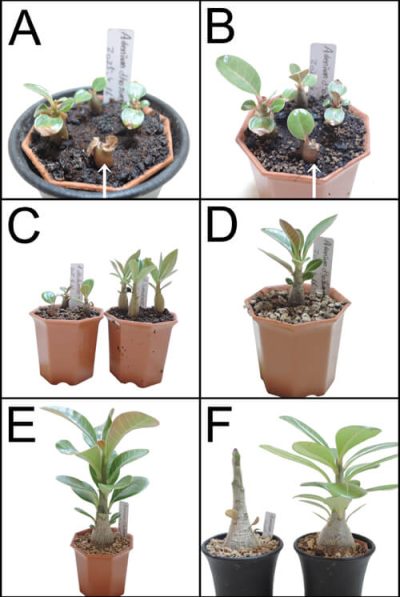
Figure 1
Phenological transitions in Adenium dhofarense demonstrating strict environmental requirements for growth activation. (A) Severe leaf abscission under partial shade (30 June 2025, Day 75), with white arrow indicating nearly defoliated individual; (B) improved leaf retention under full sun but continued growth suppression under moderate temperature (30 July 2025, Day 105); (C) comparative development showing A. dhofarense (left) severely delayed relative to A. somalense (right), which was germinated 69 days later under identical conditions, demonstrating species-specific threshold requirements (21 July 2025); (D) focal individual D-1 at onset of rapid growth phase following dual-threshold attainment (6 August 2025, Day 112); (E) continued rapid caudex expansion under sustained high temperature and high irradiance (18 September 2025, Day 156); (F) final development showing substantial growth during the brief threshold-exceeding period (18 November 2025, Day 216).
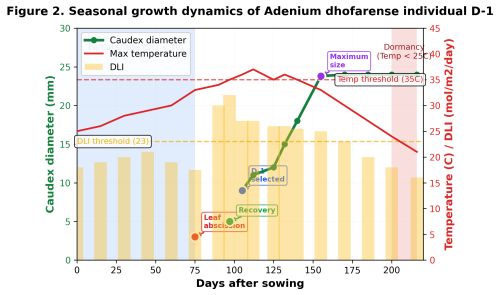
Figure 2
Seasonal growth dynamics of A. dhofarense individual D-1 in relation to environmental thresholds. Caudex diameter (green line, left axis) plotted against days after sowing, with maximum daily temperature (red line, right axis) and estimated daily light integral (DLI, yellow bars). Key phases annotated: partial-shade stress period (Day 0–76, blue shading), full-sun transition with sub-threshold temperature (Day 76–105), rapid growth phase coinciding with dual-threshold attainment (Day 105–156, temperatures ≥35°C and DLI ≥23 mol m⁻² day⁻¹), and dormancy onset under declining conditions (Day 156–216, pink shading). Growth rate increased 3.5-fold when both environmental thresholds were exceeded simultaneously. DLI was estimated using: DLI ≈ (PPFD_est × sunshine_hours × 0.5) / 1000, where PPFD_est ≈ irradiance (W·m⁻²) × 2.1.
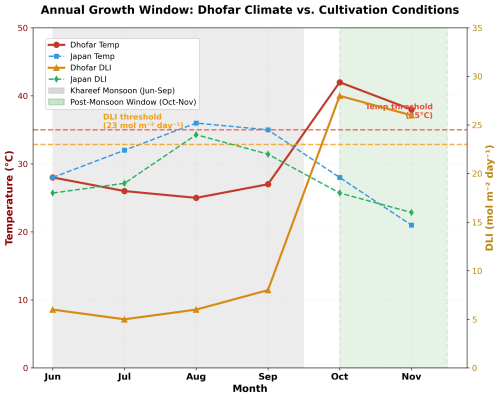
Figure 3
Conceptual model of A. dhofarense annual growth window in relation to Dhofar’s hyper-seasonal climate. The khareef monsoon (June–September) provides moisture but insufficient temperature and irradiance (estimated DLI 5–8 mol m⁻² day⁻¹, temperatures 22–28°C). The brief post-monsoon window (October–November) provides the only period meeting dual thresholds (temperatures 40–45°C, estimated DLI 25–31 mol m⁻² day⁻¹), enabling rapid growth. The extended dry season provides adequate irradiance but insufficient moisture. Climate-driven alterations in monsoon timing or intensity could contract or eliminate this narrow growth window, threatening population viability.
Funding
This research did not receive any specific grant from funding agencies in the public, commercial, or not-for-profit sectors.
References
- Attada, R., Dasari, H. P., Parekh, A., Chowdary, J. S., Langodan, S., Knio, O., & Hoteit, I. (2019).
The role of the Indian Summer Monsoon variability on Arabian Peninsula summer climate.
Climate Dynamics, 52, 3389–3404.
https://doi.org/10.1007/s00382-018-4333-x - Ehsan, M. A., Dasari, H. P., Ashok, K., & Hoteit, I. (2025).
Dynamics of intensification of extreme precipitation events over the Arabian Peninsula derived from CMIP6 simulations.
npj Climate and Atmospheric Science, 8, 82.
https://doi.org/10.1038/s41612-025-01016-w - Horisk, K. E., Ivory, S. J., Lézine, A.-M., Watrin, J., & Renson, V. (2023).
Vegetation dynamics in Dhofar, Oman, from the Late Holocene to present inferred from rock hyrax middens.
Quaternary Research, 116, 12–29.
https://doi.org/10.1017/qua.2023.42 - Horisk, K. E., Ivory, S. J., Lézine, A.-M., Watrin, J., & Renson, V. (2024).
Late Holocene hydrologic variability and ecosystem structure from rock hyrax middens in Dhofar, Oman.
Frontiers in Earth Science, 12, 1441323.
https://doi.org/10.3389/feart.2024.1441323 - Lichter-Marck, I. H., & Baldwin, B. G. (2023).
Edaphic specialization onto bare, rocky outcrops as a factor in the evolution of desert angiosperms.
Proceedings of the National Academy of Sciences, 120(6), e2214729120.
https://doi.org/10.1073/pnas.2214729120 - Lüttge, U. (2008).
Physiological Ecology of Tropical Plants (2nd ed.).
Springer, Berlin. - Midgley, G. F., & Thuiller, W. (2007).
Potential vulnerability of Namaqualand plant diversity to anthropogenic climate change.
Journal of Arid Environments, 70, 615–628.
https://doi.org/10.1016/j.jaridenv.2006.11.020 - Nelli, N. R., Francis, D., Fonseca, R., Wehbe, Y., Mandous, A. A., Tayabji, F., Ghazal, Z., & Weston, M. (2025).
Drivers and trends of summertime convection over the southeastern Arabian Peninsula.
Geophysical Research Letters, 52, e2025GL118960.
https://doi.org/10.1029/2025GL118960 - Rao, K. K., Abish, B., Sabin, T. P., Ashok, K., Mitra, A. K., & Goswami, B. N. (2024).
Future changes in the precipitation regime over the Arabian Peninsula with special emphasis on UAE: insights from NEX-GDDP CMIP6 model simulations.
Scientific Reports, 14, 73.
https://doi.org/10.1038/s41598-023-49910-8 - Rzepecky, A. (2015).
Adenium dhofarense sp. nov.: A long-overlooked species from the central-southern part of Oman.
Cactus and Succulent Journal, 87, 129–135.
https://doi.org/10.2985/015.087.0306 - Vale, C. G., & Brito, J. C. (2015).
Desert-adapted species are vulnerable to climate change: Insights from the warmest region on Earth.
Global Ecology and Conservation, 4, 369–379.
https://doi.org/10.1016/j.gecco.2015.07.012
Data Availability Statement
Environmental data (temperature, irradiance) were obtained from the publicly accessible NEDO METPV database (https://www.nedo.go.jp/library/nissharyou.html). Dhofar solar irradiance estimates are based on published regional data. Morphological measurement data and photographs are available from the author upon reasonable request.